On January 14, Google launched a feature that will reshape how billions of people interact with AI.
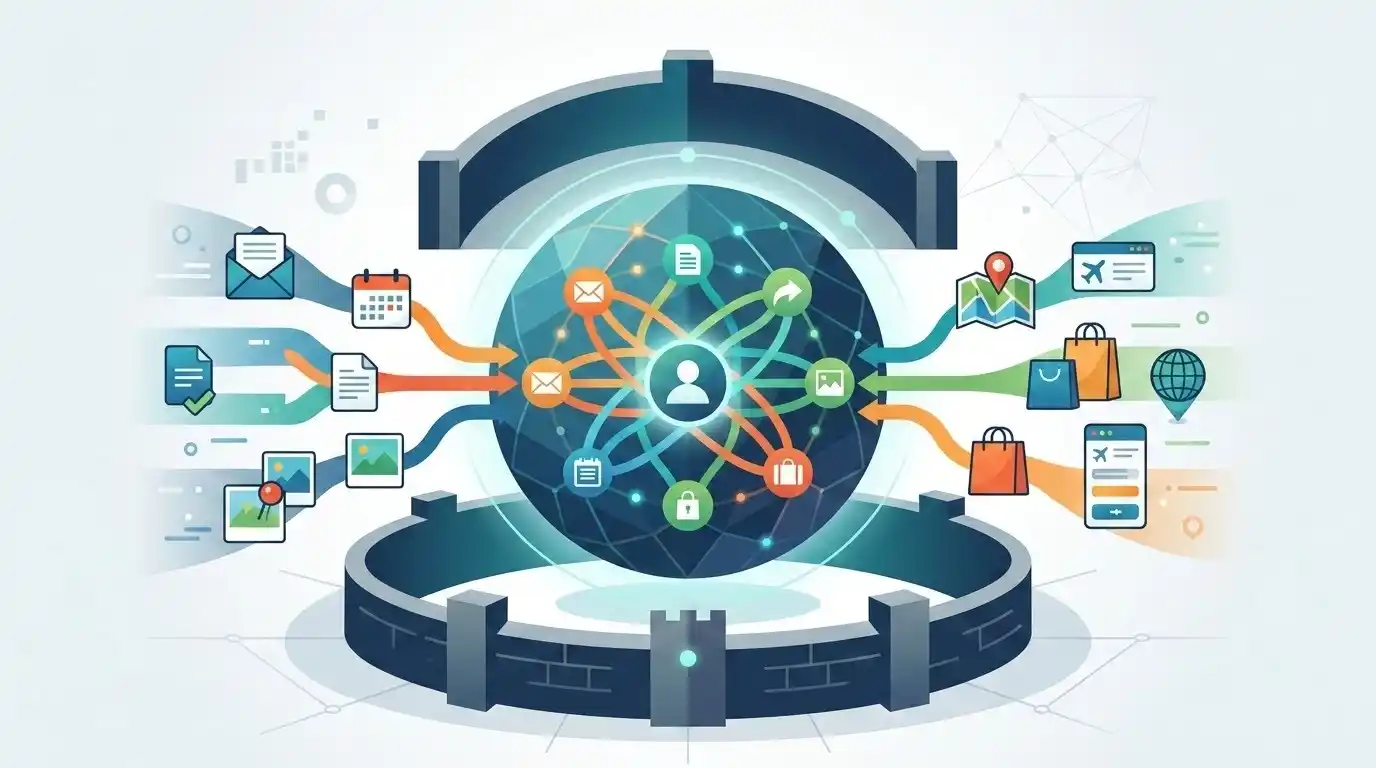
Personal Intelligence, now in beta inside the Gemini app, connects your Gmail, Google Calendar, Drive, Docs, Photos, YouTube watch history, Maps, Shopping, Flights, Hotels, and Search data into a single context layer. Your emails, your schedule, your documents, your photos and videos, your navigation history, your shopping habits, your travel bookings, your search history. All of it, woven together so Gemini can reason across your entire digital life. That's not a chatbot. That's a personal assistant.
The Scale of What's Coming
Personal Intelligence is currently in beta, available only to paid Google AI Pro and Ultra subscribers in the U.S. But Gemini now has over 750 million monthly active users worldwide, and Google has confirmed plans to bring Personal Intelligence to the free tier and expand it globally. This isn't a niche experiment. It's a staged rollout to a massive audience.
Then there's Apple. The same week, Apple announced a multi-year partnership to power the next generation of Apple Foundation Models with Gemini. The new AI-powered Siri, expected later this year, will run on Google's models. Tim Cook confirmed that Google's technology will be the backbone of the personalized Siri.
Read that again. The two companies that control nearly every smartphone on Earth are collaborating on context-aware AI powered by your personal data. Between Android and iPhone, personal context is about to become a default feature of the AI experience for the majority of the planet's connected population.
If even 10% of Gemini's user base turns on Personal Intelligence once it reaches the free tier, that's 75 million people building personal context libraries. Among paying subscribers, the opt-in rate will be much higher. Tens of millions of people are about to discover what we've been writing about in this series: AI with personal context is a fundamentally different experience than AI without it.
Why This Matters
Google doesn't plan a rollout to 750 million people on a whim. When they make personal context a first-class feature of their flagship AI product, it confirms what we've argued since Part 1 of this series.
Context is the breakthrough. Not model size. Not benchmark scores. The AI assistant that knows the most about you will always deliver the most value, regardless of which model powers it.
Personal Intelligence is Google's bet that this is true. The Apple partnership is their bet that it's true at civilization scale. Millions of people will try context-aware AI, experience the difference, and never want to go back. That's great news for the entire personal context ecosystem.
The Catch
Here's the part Google isn't highlighting in the marketing materials.
Personal Intelligence isn't just a feature. It's a retention mechanism. Every email Gemini reads, every calendar event it references, every photo it analyzes, every Maps trip and YouTube recommendation it factors in builds a richer model of who you are. That model makes Gemini more useful, which makes you more reliant on it, which makes you less likely to switch to any competitor that doesn't have your context.
This is the context moat we described in Part 5 of this series, playing out exactly as predicted. Google is building a wall around your personal data, and they're making it feel like a service. It's opt-in, you choose which apps to connect, you can turn it off anytime. But here's the question they'd rather you didn't ask: can you take your personal context with you if you switch to a different AI?
The answer is no. Your Personal Intelligence profile lives inside Google's ecosystem. There's no export button. No interoperability standard. If you spend a year teaching Gemini your preferences, your travel habits, your family's schedules, and then decide you'd prefer a different AI, you start from scratch. Google knows that. It's the entire point.
And the privacy picture is more nuanced than the marketing suggests. Google says it doesn't train directly on your Gmail inbox or Photos library. But dig into the help pages and you'll find that Gemini does train on summaries, excerpts, and inferences generated from your data, unless you manually turn off the “Keep Activity” setting. Your raw emails aren't fed into the model, but the derivative intelligence extracted from them is. And that derivative profile? You don't own it. You can't export it. You can't take it to a competitor.
This Is Only the Beginning
Personal Intelligence is impressive. But the AI powering it is still first-generation. Today, it's a search-class assistant: you ask a question, it reasons across your data, it gives you an answer. Useful, but limited.
Now imagine what happens when AI gets dramatically more capable, and all of this personal context is bolted on. That's when things get transformational. We're heading toward always-on, autonomous AI agents, like the OpenClaw system we described in Part 6, that run continuously in the background and don't wait for you to ask. They just take care of things.
Your AI isn't waiting for you to ask if your car needs service. It already checked the mileage from your connected apps and booked the appointment. It's not waiting for you to find a babysitter for Friday night. It already knows you have dinner reservations from your calendar and your usual sitter's availability from your message history. It's not waiting for you to dig through your camera roll before a friend's birthday party. It already found the 20 best photos of you together and sent them to your phone.
To do any of that, the AI needs to know you deeply. The deeper the context, the more powerful the agent becomes. At that stage, personal context won't just be helpful. It will be everything. And if that context is locked inside a single company's ecosystem, you won't just be inconvenienced by switching costs. You'll be trapped.
Google just proved that personal context is the future of AI. They also showed that the biggest players plan to own that future outright. If you want a say in how your digital memory is used, the time to act is before hundreds of millions of people get locked in.
This is Part 7 of our series: “The Personal Assistant Revolution: How AI Will Make Everyone Successful.” (Read Part 1, Part 2, Part 3, Part 4, Part 5, and Part 6 here)
The Context Layer: your bi-weekly briefing on personal context in AI and the fight for your digital memory.
Written with Claude Opus 4.6