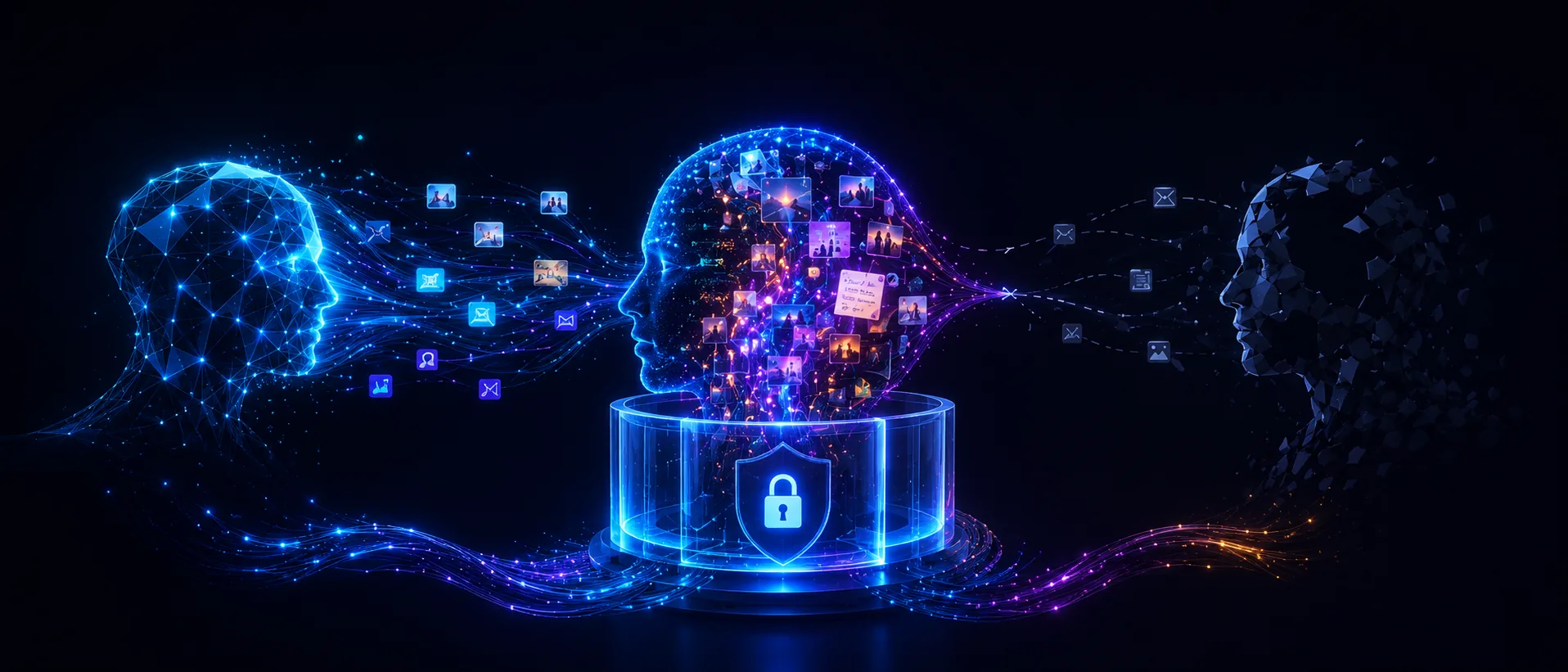
Context is one of the great amplifiers of intelligence. Give a capable AI the right context and it gets sharp. Give it none and it guesses. The studies only put numbers on what you feel the first time it happens. A 2025 study called SAGE found that handing a model exactly the context a task needs, rather than a generic start, lifted the quality of its work by 61 percent. OpenAI’s own evaluations this month show the same. Feed it your context and it stops treating every task like it just met you.
We have made this case across the series. What matters now is who controls all that context.
The file you can’t see
Matas Jonaitis, who writes the popular DailyChatGPT newsletter, recently put this in front of a lot of people. Ask ChatGPT what it knows about you, he says, then read the answer slowly. It hands you your age range, roughly where you live, a guess at your income, how you handle stress, even traits you have never said out loud. He points out that ChatGPT keeps two files on you. One you can see and delete, a short list of saved facts. One you cannot, a profile it assembles on demand from everything you have ever typed, with no list and no off switch. His rule of thumb: anything you would not say on a podcast, you have probably already told it.
He is right to be unsettled. A read this intimate, pulled from a server you do not control and used in ways nobody has explained, is a real problem. So he tells people to take it back: surface it all, delete the saved facts, switch memory off. You can read his full walkthrough here. That last step is where he goes wrong.
Delete it and your AI gets dumb again
Once you have worked with an AI that holds your context, the one without context feels broken. You are choosing to sit across from something you could easily make smarter and keeping it dim. Strip the context out and it pitches the wrong audience or suggests a trip to Barcelona because it has no idea what you like.
We called this the bitter lesson of personal AI in Part 2. Rich Sutton’s original taught researchers that feeding a model more data beats clever hand-coded rules. The personal version is blunter. The AI with your context beats the smarter AI without it. People clear their cookies without a thought. They will not give up the context that finally made their AI feel like it gets them.
You did not choose to depend on this
Nobody decided to hand a company this much. Your context accumulated slowly. Every conversation, document, and remembered preference built a picture of you: how you write, what you care about, the decisions you have made, the work and people in your life. That picture is what makes the assistant so good, and what makes it hard to leave.
Every lab has spent two years deepening it. ChatGPT started with a few saved facts and now reads your whole history in the background, and this month it began giving that memory to free users too. Google launched Personal Intelligence across your Gmail, Photos, Maps, and Calendar, then added Workspace Intelligence for your Docs, Drive, and Chat. Anthropic built Projects and Cowork so Claude works straight from your files. None of it announced itself as a turning point. It just became the floor.
Once your context is wired into how you work, leaving costs you real productivity: the output that makes you look good at the office or in class, the things you actually get done.
The lock-in is the point
And the labs are in no hurry to let your context move. Try to carry it to another assistant and the migration tools barely work: no clean export, no shared format, nothing that hands years of understanding to a rival. That is not an unfinished feature, it is the strategy: the more context one assistant holds, the harder it is to walk away. They are not racing to serve you better than the next AI, they are building so you never try the next AI at all.
The new OpenClaw agents pull the knot even tighter. The labs are all rushing out their own versions, the open-source assistant we covered in What a Lobster Can Teach Us About Context: Google’s Gemini Spark, Microsoft’s Scout, Meta’s Hatch, Perplexity’s Computer, and Hermes from Nous Research. By the end of 2026 there will be at least ten worth using, and the best one will not stay the best for long. You will want to switch. They are building walls around your context so you cannot, not without leaving your smarter AI behind.
Protect your privacy. Keep your smart AI.
Here is the choice the delete-it advice forces on you: keep a brilliant assistant that knows you well, or protect your privacy. You should not have to choose.
And privacy is the right worry. This is the most intimate read of you any system has ever produced, one the model can assemble on demand from everything you have told it, and you cannot see it or control where it goes. The labs promise not to train their models on it. Who cares. The real questions are who gets to read it, what it will sell you, and how it will steer you.
So protect your privacy. Just do not burn down your AI to do it. The answer is not less context, it is owning the context you have, keeping it where you control it, and feeding it to whichever assistant earns your work this month. Delete it from their servers and you lose nothing, because you still hold the original. That is what we are building at Bot Food: a personal context library that belongs to you and travels with you, so switching costs nothing and the profile stays in your hands.
Picture what deep context buys you. We opened this series with Courtne Smith, who grew up with Drake and became his assistant. She knew his tastes, history, and patterns so well she saw what he needed before he asked, and helped run a $400 million career. That is context as an amplifier, in human form, once reserved for the rich. Context-aware AI is about to hand a version of it to everyone.
The answer was never to make your AI forget you. Keep it, just keep it yours.
The Context Layer: your regular briefing on personal context in AI and the fight for your digital memory. Read the full series at ralhf.ai/blog.