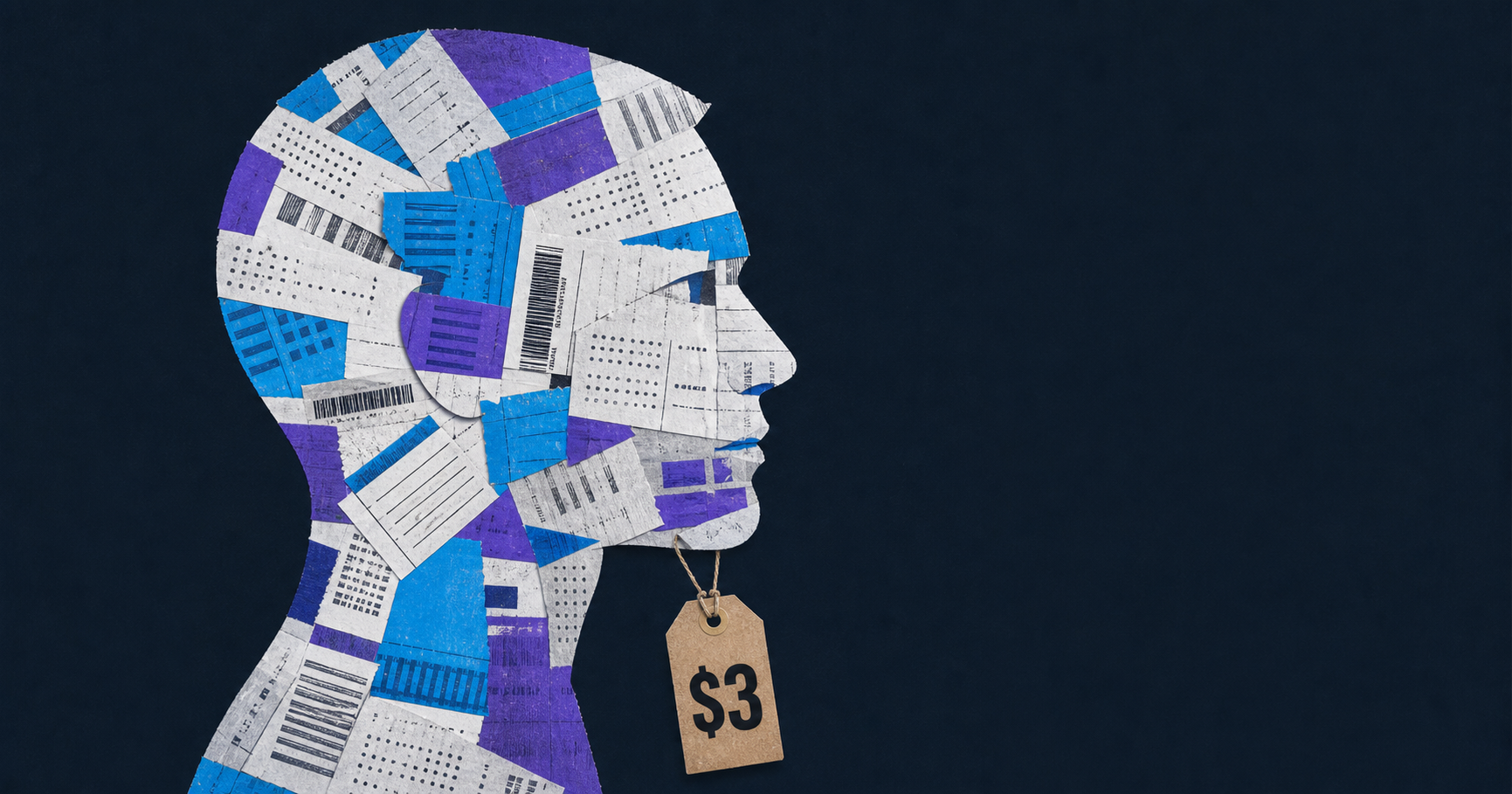
The ten thousand or so facts a broker like Acxiom holds on you, your purchases, your address history, your car, your kids, your credit, all bundle into a single profile that sells for about three dollars. A rough worldwide average, and it holds up the entire trillion-dollar advertising business. Less than the coffee you were drinking while you generated it.
That profile sells for three dollars, but the company holding it earns closer to fifty dollars a year renting you to advertisers. You are a three-dollar asset that pays a fifty-dollar dividend. That gap is why every AI lab is suddenly desperate to remember you.
An AI that knows your context, your projects, your history, your taste, beats one that meets you cold every morning. That is the reason every lab has spent the past year shipping memory features. But the same memory rebuilds that three-dollar broker profile into something no data broker could ever assemble.
The old advertising ecosystem
The old ad ecosystem was clumsy and enormous. Retailers, card networks, and apps sell aggregated data about what you do. Brokers like Acxiom, Epsilon, and Experian buy it and stitch it into a profile of up to ten thousand attributes, matched back to your name by identity platforms like LiveRamp’s AbiliTec. Advertisers buy against that profile and hope it is close enough to sell you something. The whole apparatus exists to guess one thing, whether you are about to buy, and even in a trillion-dollar industry most of the guesses are wrong.
We know roughly what a profile fetches, because these data businesses change hands. When Interpublic bought Acxiom’s marketing data in 2018, it paid $2.3 billion for records on about 2.5 billion people, a little under a dollar a head, and that included the technology and client contracts on top of the data. The deal is old, and a worldwide average always runs low, dragged down by thin files in poorer markets. For an engaged consumer in 2026, three dollars is a fair mark.
The new AI machine already knows
Now you tell an AI what you actually want. Where to travel, which laptop to buy, how to handle a diagnosis, what to cook for someone who can’t eat gluten. No cookie ever caught that, and no broker ever sold it. The AI holds your life as memory and builds the profile on demand the second it needs one. It can read your whole past into a portrait of who you are, and it can watch you in real time for the exact moment you are ready to buy. The result is a hundred to a thousand times richer than the old data broker file, and it carries intent and patterns you have never said out loud.
Strip away the labels and the data broker’s profile, the AI lab’s memory, and the industry’s identity graph are the same thing: your context. The record that makes your AI brilliant is the exact record they rent to advertisers.
AI memory and history arrive switched on, and by a widely cited estimate around ninety-five percent of people never change a default. The labs are not stealing anything, they are keeping what nearly all of us hand over by leaving the switches where we found them, and that steady, unedited record is what builds the intimate profile. It deepens while you sleep: in May, Anthropic shipped a feature it calls dreaming, a background process that reads back through your day and consolidates it, and OpenAI runs its own version. Soon it will be everywhere. The always-on agents rolling out now, Google’s Gemini Spark, Microsoft’s Scout, and Meta’s Hatch, will handle whatever you need, and everything they touch feeds the same file.
What it is worth at AI scale
If that context is a thousand times richer than the broker file, the three-dollar asset becomes something like three thousand dollars a person, throwing off maybe fifty thousand a year. Pick your own multiple, the direction is what matters. And that is only advertising, the business we already understand. New technology does the old jobs first, then invents ones nobody could see from the start. Everyone thought Airbnb was fighting for a slice of the hotel market, when the real market turned out to be every spare room on earth, far larger than hotels. Advertising is a trillion dollars today. Ten years out it could be five or ten trillion, and the most valuable uses of your personal context are probably ones we can’t picture yet.
The volume of data is not the frightening part. A model trained on what a billion people do every week can read your context and call your next move, then the one after that, better than you can. That prediction is the product. There is no file to subpoena and no profile to hand over, only a system that reads you a few steps ahead and rents that prediction to whoever is buying.
You should own your context
You can’t stop this from being built, but you can own a copy of it. Every app, account, card, and device you touch holds a piece of you, scattered across dozens of services today where you can’t reach it. The Open Memory Alliance exists to change that: you have a right to a single copy of your whole context, held by you, used only by whoever you allow, and eventually earning for you.
Your digital footprint is growing fast, and for the first time it will be worth real money, both as the data that makes AI genuinely great and as income you can eventually collect. It sells for three dollars today. In ten years it could be the most valuable thing you own, and right now it is being built entirely without you.
The moment to take control is while it still costs nothing. If you care about owning your digital memory, sign the OMA charter.
The Context Layer: your briefing on personal context in AI and the fight for your digital memory. Read the full series at ralhf.ai/blog.