
If you wanted a billion people to hand their entire lives to your AI, who would you hire to make them feel safe doing it?
Mark Zuckerberg’s answer is a man named Moxie Marlinspike. About ten years ago Moxie made the messages of more than a billion WhatsApp users unreadable to anyone outside the conversation, Meta included. Now Meta wants him to do the same for Muse, its personal agent. “Nat and I personally recruited Moxie Marlinspike to work on this confidential VM project,” Zuckerberg said in September, referring to Nat Friedman, one of the leaders of Meta’s AI lab.
Why trust is the whole job
ChatGPT brought AI to consumers, and four years later Muse brought them personal agents: an assistant that works for you around the clock, learns more about you than most of the people in your life, and handles almost anything digital you give it. More than 10 million people set Muse up in its first six weeks. Meta calls this personal superintelligence, and once millions of people have one working for them day and night, the way they run their lives will look nothing like it does today.
But Muse only works if people give it access to everything. An agent that plans your trips, manages your calendar, handles your email and does 100 other things needs access to your bank, your health records, all of your messages and so much more if it’s going to do the job well, and nobody hands those over to a company they don’t trust.
Who Moxie is
Moxie co-founded Signal, the messaging app security experts use themselves, and co-wrote the encryption it runs on. Before that he ran security at Twitter. From 2014 to 2016 he worked with WhatsApp to build the same encryption into every chat, which is why Meta can’t read your WhatsApp messages today.
Earlier this year he launched Confer, a private AI chat app built so that nobody but you can read your conversations, not even Moxie. In March he agreed to bring that technology to Meta AI, and now he is building the Muse Confidential VM. A VM, or virtual machine, is a private computer running inside a data center, and this one is encrypted with a key only you hold. Meta says it arrives before the end of the year.
What Moxie is building for Muse
Meta hasn’t published the full design, but Confer and the private AI system Meta already runs for WhatsApp show exactly how Moxie builds these things. Every AI app has three main parts, which people in the field call the model, the harness and the data. The model is the AI that does the thinking, the harness is the software around the model that runs the agent and gets tasks done, and the data is what the agent knows about you.
With Muse, that data comes in two parts: data inside the app, which is what Muse remembers from your conversations, and data outside the app, which is everything held by your other apps.
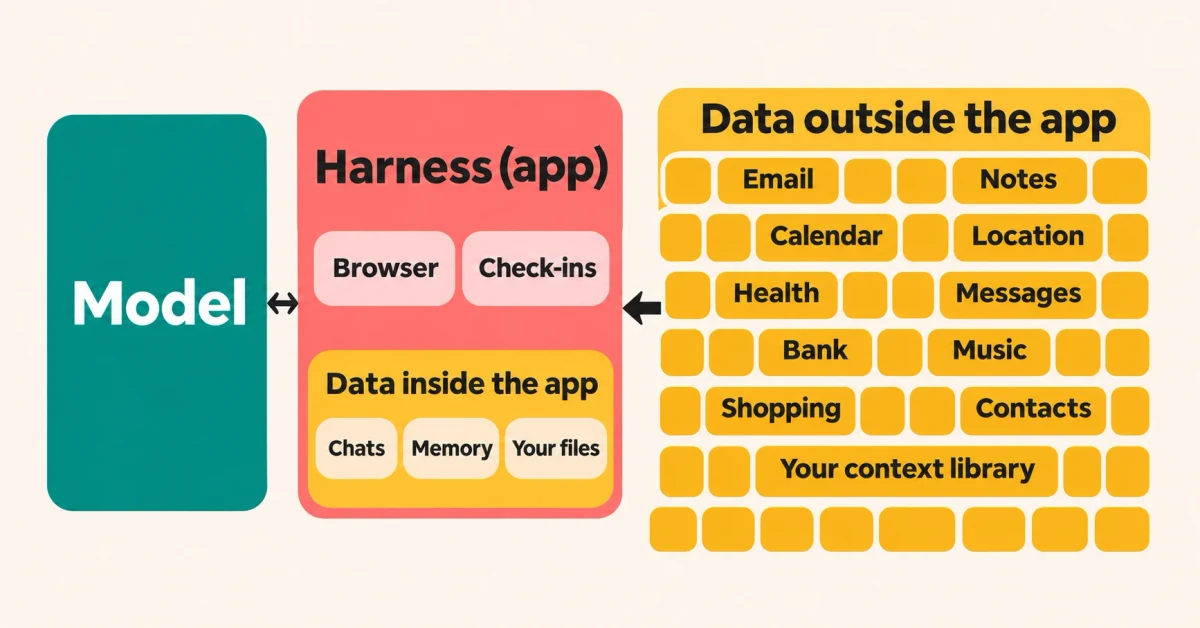
The model runs on its own private machine, takes one request at a time, answers it, and forgets it. The harness runs on your Confidential VM: Muse’s own web browser, the schedule that wakes Muse every half hour to check what needs doing, a password manager that logs in for you without Muse ever seeing your passwords, and the connectors Muse uses to pull information from your other apps. The data inside the app sits on the VM too, in the memory system we described in our last piece, your conversations and everything Muse works out from them.
Where the rest of your context lives
A private computer that even Meta can’t read is a big step, and an agent this personal needs one. The data outside the app doesn’t live on that computer, though. Your email, calendar, bank, health records and shopping history etc stay with the companies that already hold them, and Muse pulls pieces in through connectors when a task calls for them. Muse already offers more than 50 connectors.
Each connector links to a different company, usually through that company’s API, and you grant access one app at a time. Your context stays spread across all of those companies, and you can never see it in one place.
Your context is the asset
Your context decides how good your agent can be. That same context is what advertisers, retailers and researchers want most, because it shows what you need and when you need it, and they will pay you for the chance to use it. Right now you can’t sell them any of it, because your context sits in fifty different places and you have no way to gather it, check it or decide who gets to see it.
A context library you control pulls all of that together, so every agent you use can draw on the same full picture of your life, and so you can decide who else gets to use it and what they pay you for it. Moxie is making sure Meta can’t read your conversations with Muse, while your email, bank, health records and the rest of your context are still spread across fifty other companies.
The Context Layer: your briefing on personal context in AI and the fight for your digital memory. Read the full series at ralhf.ai/blog.